Colossi of Memnon
Ancient Thebes · Egypt
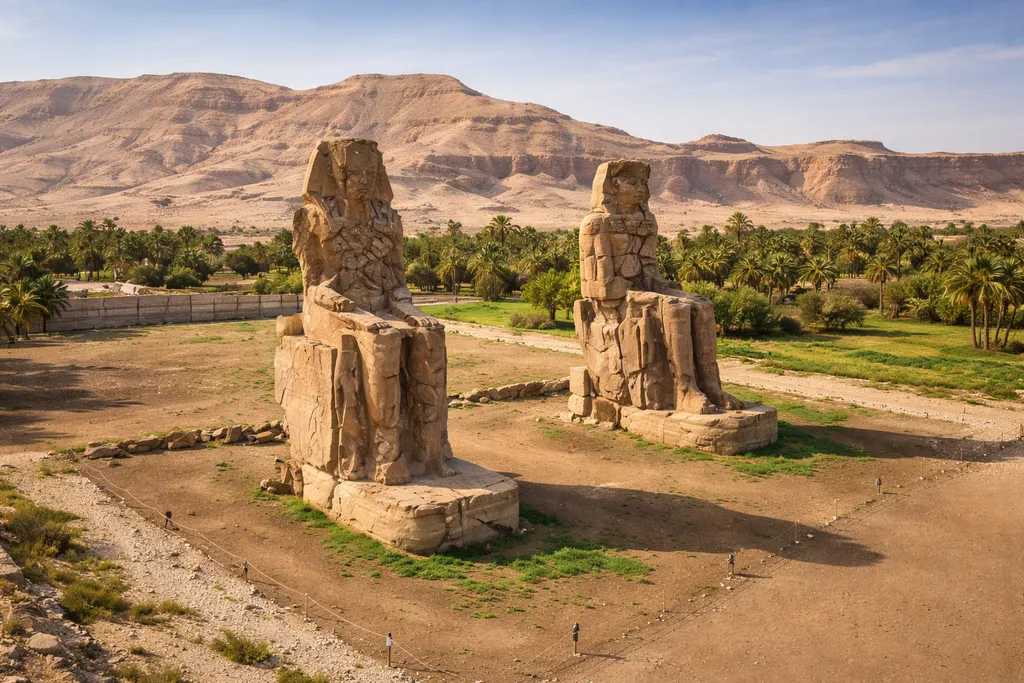
Two monumental seated statues on Luxor’s West Bank, originally flanking the entrance of Amenhotep III’s vast mortuary temple (Kom el-Hettan) and later famous in the Greco-Roman world as the ‘Vocal Memnon’.
Part of
Claims about Colossi of Memnon
- Older quarry-source hypotheses exist, but recent evidence narrows the field
- Built as entrance guardians for Amenhotep III’s mortuary temple
- ‘Memnon’ is a Greco-Roman cultural overlay (interpretatio graeca)
- Iconography identifies the seated figures with Amenhotep III (not ‘Memnon’)
- Mineral fingerprinting supports a Gebel el-Ahmar quarry source for the colossi stone
- The ‘Vocal Memnon’ phenomenon is historically attested
- A natural (physical) mechanism is a strong candidate explanation for the ‘voice’
- Roman-era repairs around 200 CE are associated with the end of the sound reports
- Modern conservation raises questions of authenticity, reversibility, and visitor impact
- Alternative hypothesis: the ‘voice’ may have been socially or ritually ‘managed’
- The Colossi sit within the UNESCO ‘Ancient Thebes’ landscape on Luxor’s West Bank
Evidence
- Coordinate reference (DARE place entry)
- Coordinate reference (Wikidata item Q750209)
- Oxford Academic chapter: ‘Reading the Colossus: The Memnon Inscriptions’
- Primary text witness: Strabo, Geography 17.1.46
- Classical studies critique (JSTOR): ‘The Miracle of Memnon’
- Kom el-Hettan project publications list (University of Mainz, PDF)
- CC0 photo set (Livius.org)
- Artifact: The two seated colossi and their original role as temple entrance guardians
- Artifact: Greek and Latin visitor inscriptions on the colossi
- Analysis: Naturalistic mechanism proposed for the dawn ‘sound’
- Analysis: Priestly staging / ‘managed miracle’ hypothesis
- Analysis: Cultural translation—why Greeks called it ‘Memnon’
- Debate note: Quarry source debates (Gebel el-Ahmar vs other proposals)