Dragon Stones (Vishapakar) of the Geghama Mountains
Gegharkunik and Kotayk provinces, Armenia
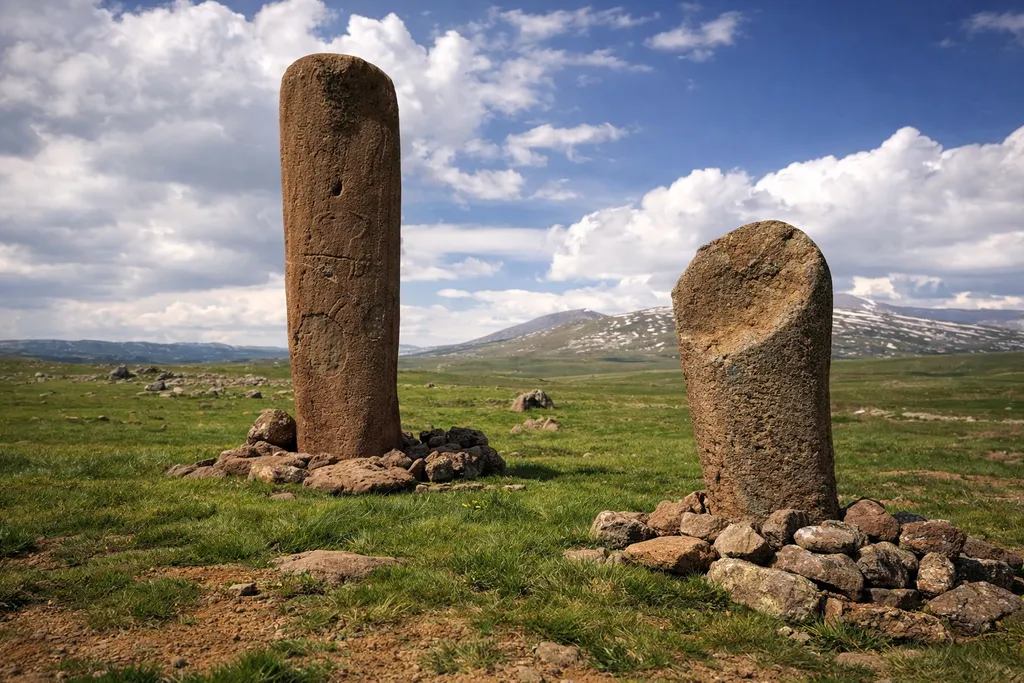
High-altitude carved basalt stelae (vishapakar, “dragon stones”) in Armenia’s Geghama (Gegham) Mountains. The monuments are best known for standardized animal iconography—especially fish and “draped hide” motifs—and for their repeated placement near water-rich summer pastures.
Claims about Dragon Stones (Vishapakar) of the Geghama Mountains
- “Dragon Stones” are vishapakar: carved prehistoric stelae in Armenia’s high mountains
- Most vishap stones share a standardized iconography: fish, ‘draped hide’, or hybrid motifs
- Vishap stones are large monoliths (often meters tall) typically carved from basalt
- Vishap stones preferentially occur at high altitudes, with clustering rather than random elevation spread
- Findspots are frequently near water-rich features such as springs, streams, and crater lakes
- Interpretation: vishap stones most likely served a religious/cult function related to water
- Alternative interpretation: some vishaps may have marked watering points, routes, or irrigation systems within pastoral landscapes
- Modern research on vishaps is organized as an international field program active since 2012
Evidence
- Scholarly and institutional sources use the terms vishap / vishapakar for ‘dragon stones’
- UNESCO dossier independently describes the same fish / draped-hide / hybrid typology
- FU Berlin press release describes Tirinkatar’s high-altitude vishap complex and UNESCO submission context
- Dataset-based analysis reports patterned elevation distribution for 115 cataloged vishaps
- Peer-reviewed analysis links vishap placement to water-rich settings and proximity to springs/water bodies
- UNESCO dossier describes vishaps as typically placed in water-rich high meadows (1200–3200 m)
- FU Berlin press release frames vishaps as religious monuments connected with water
- UNESCO dossier links Tirinkatar to nearby prehistoric canal systems (‘Twelve canals’) and broader water management narratives
- Institutional UNESCO dossier describes systematic surveys/excavations starting in 2012 by an Armenian–Italian–German team