Qasr al-Farid (“The Lonely Castle”)
Hegra (Al-Hijr) · Saudi Arabia
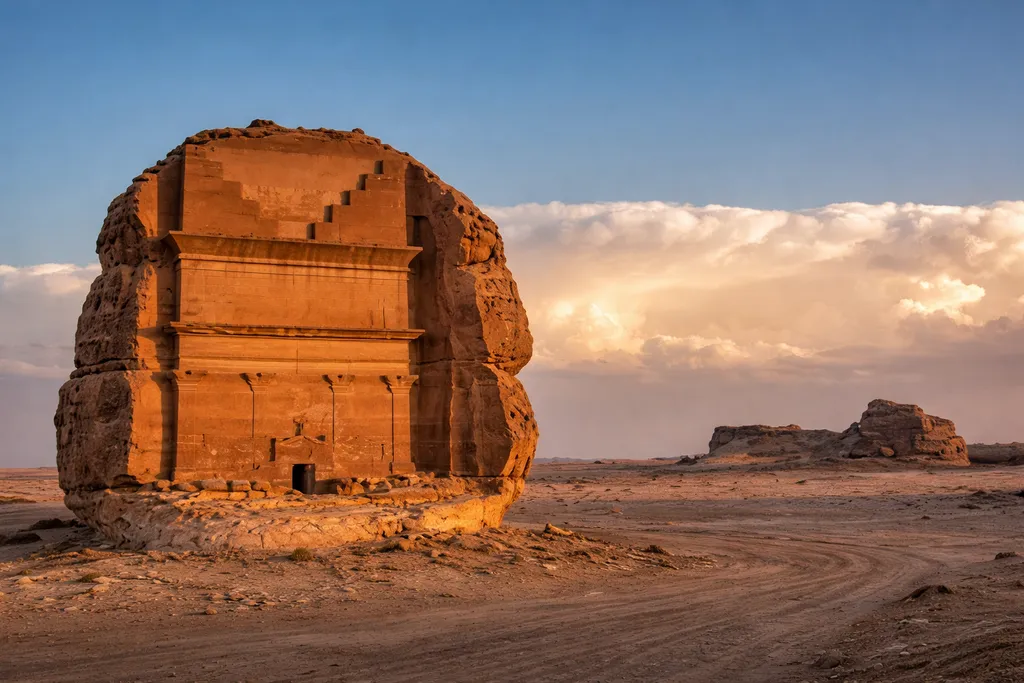
A monumental Nabataean rock-cut tomb façade in the Hegra necropolis (UNESCO World Heritage), famous for its isolated outcrop setting and seemingly unfinished carving.
Part of
Claims about Qasr al-Farid (“The Lonely Castle”)
- Qasr al-Farid is a Nabataean rock-cut funerary monument at Hegra
- Many Hegra tomb façades are independently dated by inscriptions (roughly 1–75 CE)
- “Lonely Castle” is a nickname; the monument is not a palace or fort
- The façade appears unfinished; why work stopped is debated
- “Lihyan” in the tomb’s modern labeling is likely a personal name, not the Lihyanite kingdom
- Qasr al-Farid’s precise date is inferred (style/context), not securely fixed by a dated inscription
- Its isolation may be intentional—status display and visibility from the settlement are plausible drivers
- Modern heritage management and taboos shaped research access and interpretation
- Some researchers test whether monument placement/orientation encodes astronomical or calendrical ideas
Evidence
- Saudi Press Agency: Hegra described as an ecotourism destination (2024)
- Wikidata: Qasr al-Farid item (geospatial point + identifiers)
- Wikidata: Hegra item (alternate coordinate + 'has part' graph)
- Wikipedia: Hegra page (as a map of popular framing and alternate names)
- UNESCO map coordinates for Hegra World Heritage property
- UNESCO nomination excerpt: tombs dated from 1st century BCE to ~75 CE
- Google Arts & Culture asset: Iconic tomb at Hegra
- French Archaeology Abroad: Hegra overview with Qasr al-Farid photo captioning
- Springer 2024: archaeoastronomy analysis at Hegra
- ISPI analysis: misconceptions and shifting attitudes toward AlUla’s pre-Islamic heritage
- Coordinate mismatch note: UNESCO map point vs Wikidata points differ by a few km
- Nehmé 2010: tomb façades oriented for visibility toward settlement (landscape logic)
- ICOMOS 1293: necropolis zoning and dated ranges for several tomb groups