Sigiriya Lion’s Paw Terrace (Lion Staircase), Sri Lanka
Ancient City of Sigiriya (Lion Rock) · Sri Lanka
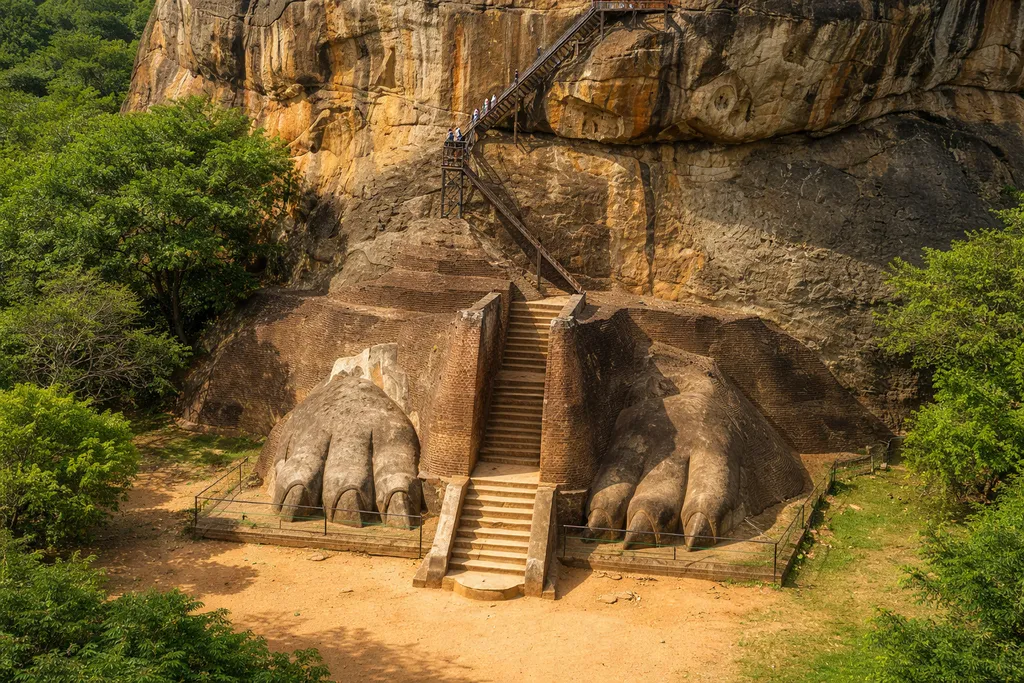
The Lion’s Paw terrace is the famous mid-ascent gateway zone of Sigiriya (Lion Rock), where monumental lion paws survive as the last remains of a once-colossal lion-shaped entrance to the royal summit complex.
Part of
Claims about Sigiriya Lion’s Paw Terrace (Lion Staircase), Sri Lanka
- The frescoes are iconic but their meaning and patronage are debated
- Sigiriya’s water gardens show sophisticated hydraulic and landscape design
- Debate lens: ‘fortress’ vs ‘garden-city’ vs ‘monastic landscape’ (what was primary?)
- The Lion Gate (only the paws remain) is central to the site’s identity
- The Mirror Wall graffiti is a major linguistic and social archive
- Sigiriya is multi-phase: early monastic shelters, royal capital, then later monastic/visitor use
Evidence
- Underground conduits and differential water levels in the Water Gardens (Bandaranayake/ICOMOS)
- Interpretations of the fresco figures vary (apsaras vs courtly figures, etc.)
- Surviving fresco set (count and prominence) as summarized by CCF
- Coordinates (decimal) as listed by InforMEA
- Graffiti as evidence for early Sinhala texts (ICOMOS evaluation)
- Lion staircase / gateway mentioned in ICOMOS evaluation
- Return to monks after Kashyapa (ICOMOS evaluation)
- Mirror Wall: polished plaster surface enabling reflection
- Comparative hydraulic analysis with Mughal gardens (Rajarata University)
- Tourism/visitor pressure and management issues (University of Peradeniya IR)
- Landscape-architectonic reading of Sigiriya (TU Delft thesis)
- Coordinates (DMS) as published by UNESCO WHC
- Sigiriya described as a fortified ‘garden city’ linked with hydraulic engineering (UoM)