Stonehenge
Stonehenge and Avebury · United Kingdom
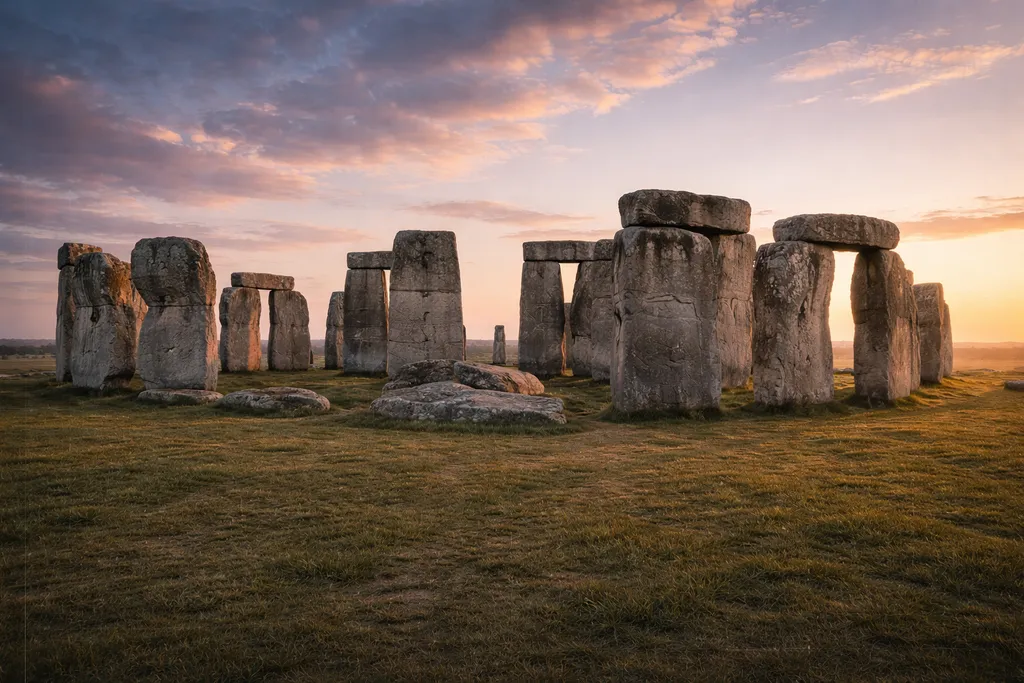
A Late Neolithic–Early Bronze Age monument on Salisbury Plain built and modified over many centuries, famous for its sarsen trilithons, imported bluestones, and solstice-aligned architecture.
Part of
Claims about Stonehenge
- Stonehenge was built and reworked in multiple phases over many centuries
- Stonehenge began as (or included) a significant cremation cemetery
- The large sarsen circle/trilithons belong to the late Neolithic (around 2500 BCE)
- Stonehenge architecture emphasizes solstitial alignments (midwinter/summer)
- Stonehenge is part of a dense ritual/mortuary landscape (Avenue, Durrington Walls, barrows)
- Debated: Medieval-origin legends may preserve distorted memories of real stone movements
- Meta-claim: Some specific stone provenances (e.g., the Altar Stone) are still being revised
Evidence
- Coordinates derived from National Grid Reference (NHLE)
- Coordinate cross-check (independent web map reference)
- Historic England NHLE list entry 1010140 (official designation record)
- Aubrey Holes cremation evidence (as summarized in NHLE entry)
- Late Neolithic sarsen settings (~2500 BCE) (EH synthesis)
- NHLE note on astronomical-alignment debate
- UNESCO WHS statement on continuous monument-building (c. 3700–1600 BCE)
- Feasting & mobility evidence at nearby Durrington Walls (Feeding Stonehenge)
- Archaeology International: testing legends against archaeology (Parker Pearson)
- Debate: ‘grain of truth’ framing around dismantled circles (Wales)
- Media reporting: Altar Stone source revised (Scotland vs Wales)